Showing posts with label Literature.. Show all posts

Sunday, January 31, 2010

Women, Snakes and Stalkers: South Asian book covers

This is a dual post with Will, from the great A Journey Around My Skull. All of these magnificent covers come courtesy of Quinn Dombrowski's impressive South Asian books project, in which she photographs book covers from the "PK" section (Indo-Iranian languages and literatures) of the University of Chicago's Regenstein library. See more covers at her blog, Women, Snakes and Stalkers, and at her flickr. And be sure to view Will's picks here.

Thank you to @weetstraw, @Coudal, @posteroffensive who first linked me to Women, Snakes and Stalkers.

(click photos to visit the corresponding post at her blog)


-
visit her blog, Women, Snakes and Stalkers [link]
also check out her flickr [link]
and her website [link]
more at A Journey Around My Skull [link]

Monday, October 12, 2009

More from the 1905-1906 Russian Underground Press

A few months back I posted images from 1905-1906 Russian revolutionary periodicals that I found at Yale University’s digital library. Recently I (accidentally) came across a related book called Blood and Laughter: Caricatures from the 1905 Revolution that contains more illustrations of the 1905-1906 Russian underground press.


from Leshii (Woodgoblin) No. 2, 1906

"Sunday 9 January 1905: Hundreds of thousand of workers assemble in the streets of St Petersburg. They are in their Sunday best and accompanied by their elderly relatives and children. There are no banners or slogans though some carry icons or church emblems, for this is to be a peaceful demonstration led by an Orthodox priest, Father Gapon. They set off for the Winter Palace, bearing to the Tsar their petition for a constitution. ‘Sire!!’ it reads. ‘We workers have come to you to seek justice and protection. We are in great poverty, we are oppressed and weighed down with labors beyond our strength. We are insulted, we are not recognized as human beings…’

For two cold hours they stand waiting in the snow for Tsar Nicholas to appear and receive their petition. A shot rings out, and they stamp their feet. Another, and they laugh that it must be blanks. A third, and suddenly women and children slump lifeless int eh snow. Still they assure themselves that this must be a mistake, for the Tsar would not shoot down unarmed civilians. But now the gendarmes are galloping in the crowd, and the slaughter has begun. The shooting continues all day long. The dead are counted in the hundreds, the wounded in the thousands, their blood spilt on the Schlusselberg Highway, the Troitsky Bridge and the Nevsky Gates. But the police cart away the bodies so quickly that it is impossible to know the full toll.

Bloody Sunday killed superstition, the old faith in a just Tsar, and unleashed a tumultuous rage among the masses. Father Gapon was soon forgotten, ‘his priestly rode’, wrote Trotsky, ‘a mere prop in the drama whose true protagonist was the proletariat’. A huge wave of strikes swept the country, paralyzing more than 100 towns and drawing in a million men and women. Throughout the summer peasants rioted while terrorists struck at figures of authority.

Alongside the struggle in street and factory was the struggle for the free press. Ministers and clerics suffered assassination more by the pen than the bullet as the revolution strove for the expression of powerful emotions long suppressed. A flood of satirical journals poured from the presses, honouring the dead and vilifying the might. Drawings of frenzied immediacy and extraordinary technical virtuosity were combines with prose and verse written in a popular underground language, veiled in allegory, metaphor and reference to the past.

Russia had a rich history of satirical journalism. In the 1770s, in the reign of Katherine the Great, an elite of intellectuals close to the court developed a new ‘aesopian’ language – deeply subversive to the enlightened autocracy – to express their opposition to the old regime. The satire of the court flourished until the shadow of revolution in Europe drove the Empress to suppress it. Again in the 1860s highly popular satirical journals sprang up, drawing consciously on their courtly predecessors to curse the Crimean War and Tsar Alexander II’s empty promises of reform. While populist revolutionaries went ‘to the people’ to make common causes with the peasants, radical journalist set out to collect folk-stories, popular sayings, soldiers’ songs and workers’ ballads. The old allegorical vocabulary was joined to the language of popular satire. By the 1870s these journals has been closed down, but this language was now part of the everyday speech. Satirical writing returned to the underground, where it flourished, rooted in popular protest, until 1905. It was then that satire achieved its full power.

Fore a few brief months the journals spoke with a great and unprecedented rage that neither arrest nor exile could silence. At first their approach was oblique, their allusions veiled, and they often fell victim to the censor’s pencil. But people had suffered censorship for too long. Satirist constantly expanded their territory and their targets of attack, demolishing one obstacle after another as they went, thriving on censorship. The workers’ movement grew in boldness, culminating in the birth of the St Petersburg Soviet of Workers’ Deputies, the people’s government. For fifty days the Tsar and his ministers were confronted by another power, another law. Journalist and printers seized the right to publish without submitting to the censor. The satirical journals then reached their apotheosis, until the revolution died as it had risen, bathed in blood.

More clearly than any party resolution or government proclamation, the caricatures of 1905 tell the story of that heroic failure – and they are a symptom of that failure too…they chronicle with incredible vividness that moment of the transition from Tsarist despotism to Bolshevik revolution." -by Cathy Porter, from Images of Revolution: Graphic Art from 1905 Russia


from K Svetu (Towards the Light) No. 3 1906


"In the State Duma. 'Interpellation'"by Alexander Kudinov. Leshii No. 1, 1906


from K Svetu (Towards the Light) No 2, 1906


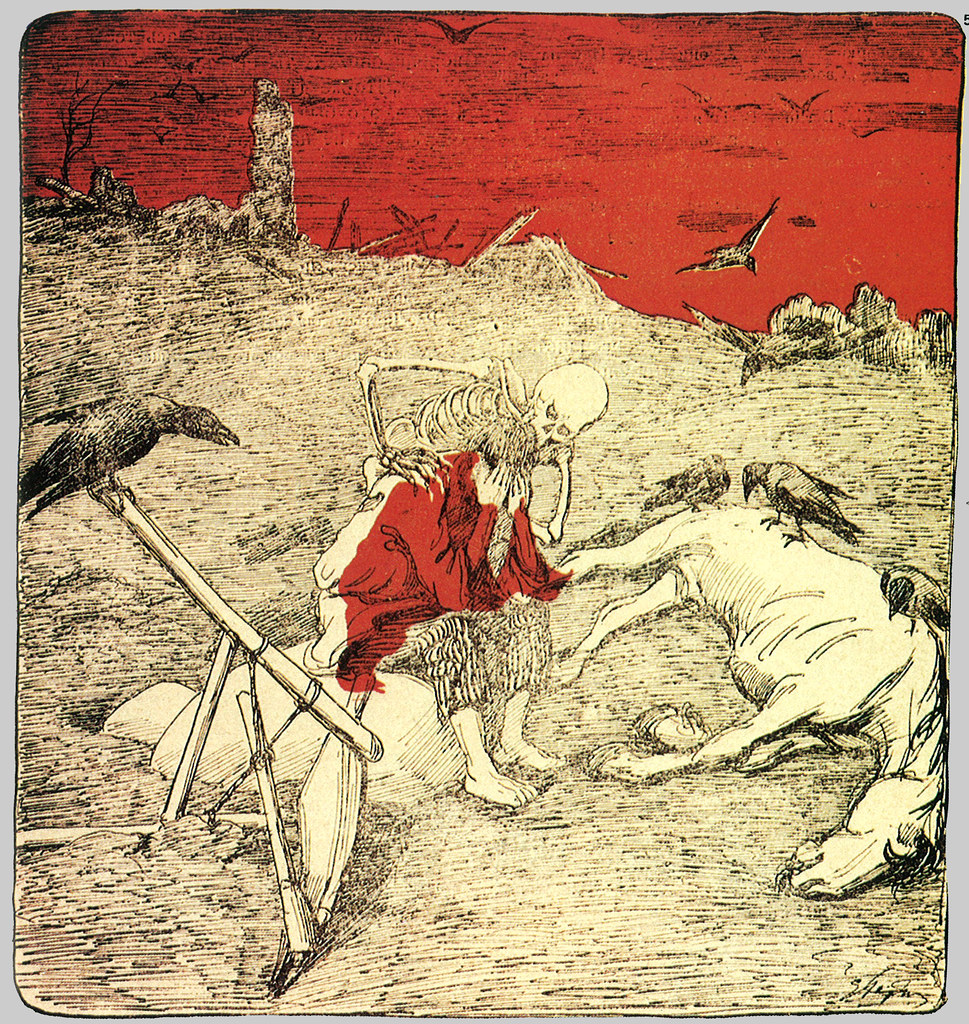
Strana Mechty (Land of Dreams) No. 1, 1906


"The Moscow Vampire" - Volshebny Fonar No. 2, 1906 (depiction of Governor-General Fedor Vasilevich Dubasov)


from Kosa No. 4, 1906


from Pchela No. 3, 1906


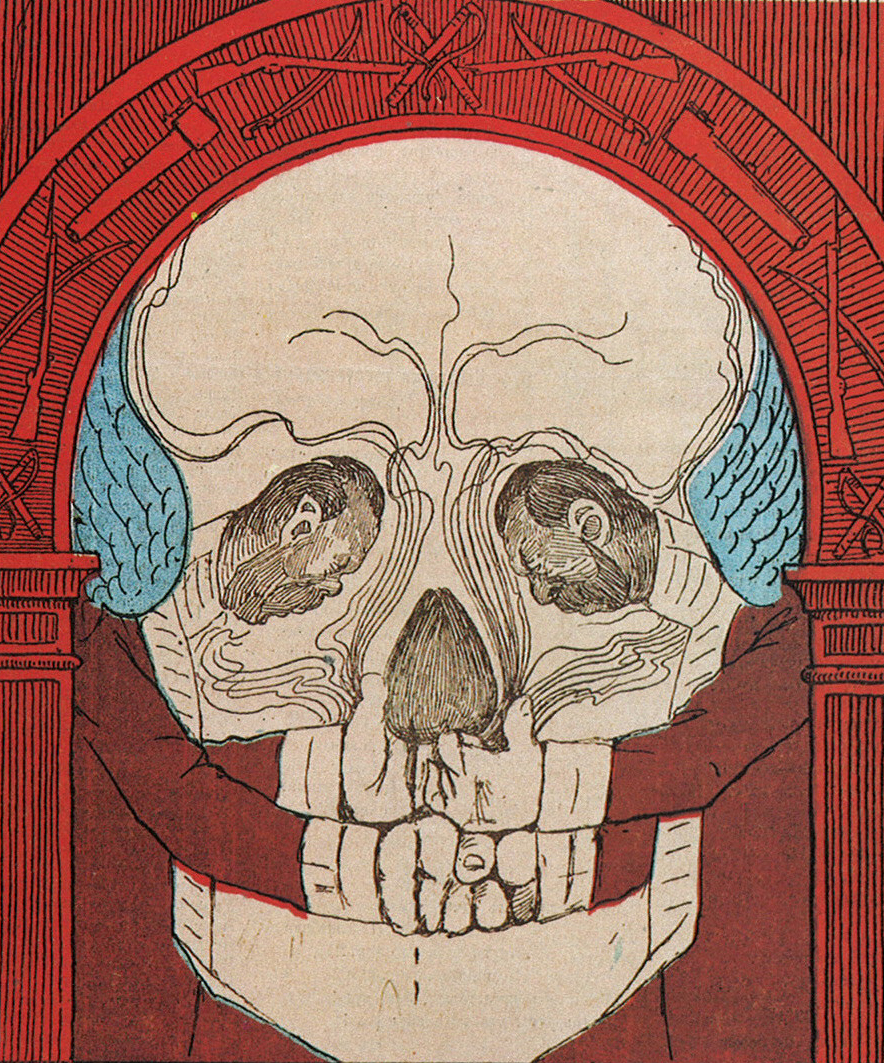
from Zarnitsy No. 8, 1906 (Witte and Durnovo burning the books)


Krasny Smekh (Red Laughter) No. 2 1906, by Boris Kustodiev


Satiricheskoe Obozrenie (Satirical Review) No. 1, 1906


"The Triumphant Pig" - Maski (Masks) No. 8, 1906


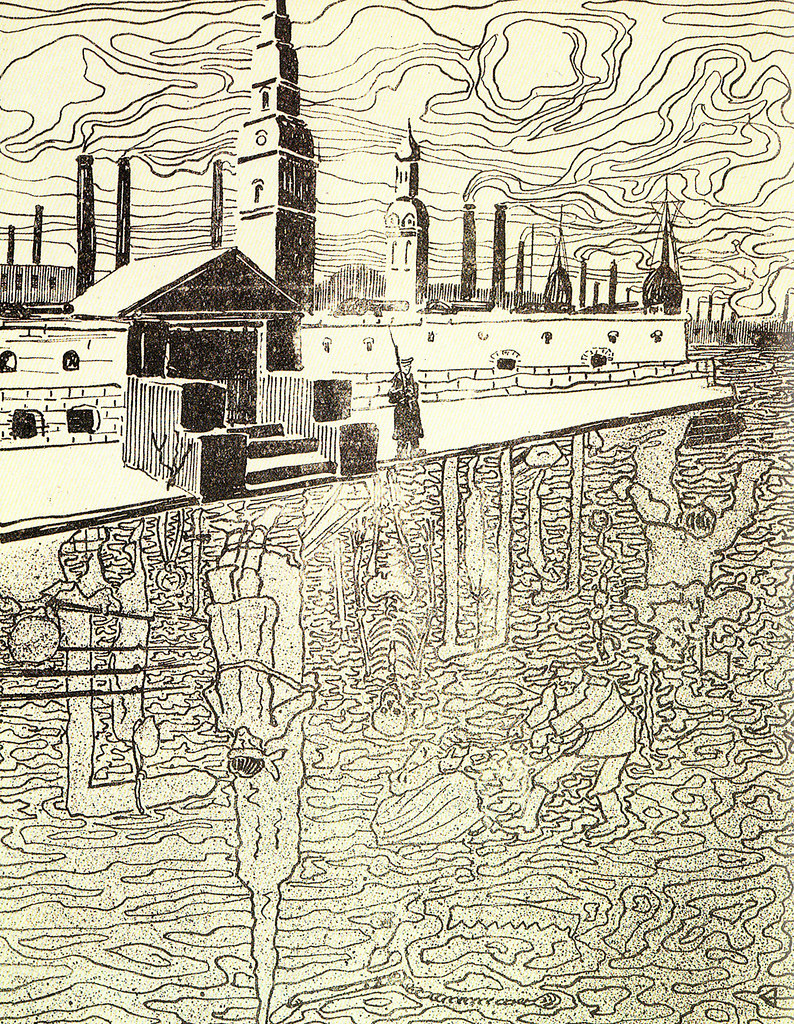
"The Treacherous Neva Reflected Everything" - Volshebny Fonar (Magic Lantern). No. 1, 1906


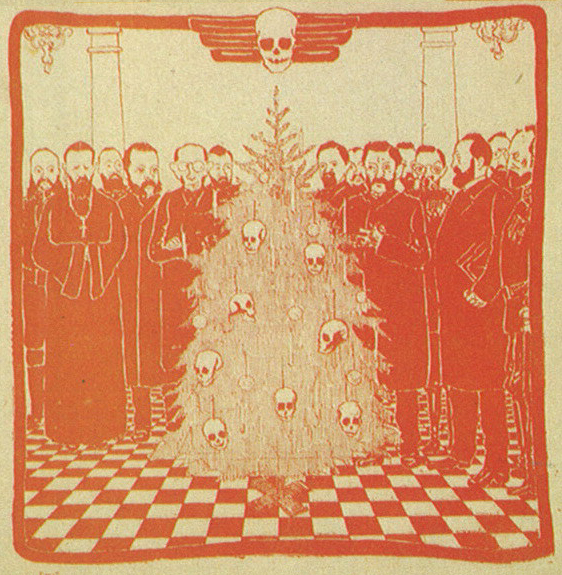
"Christmas Tree" - Burelom (Storm-Wood), Christmas 1905


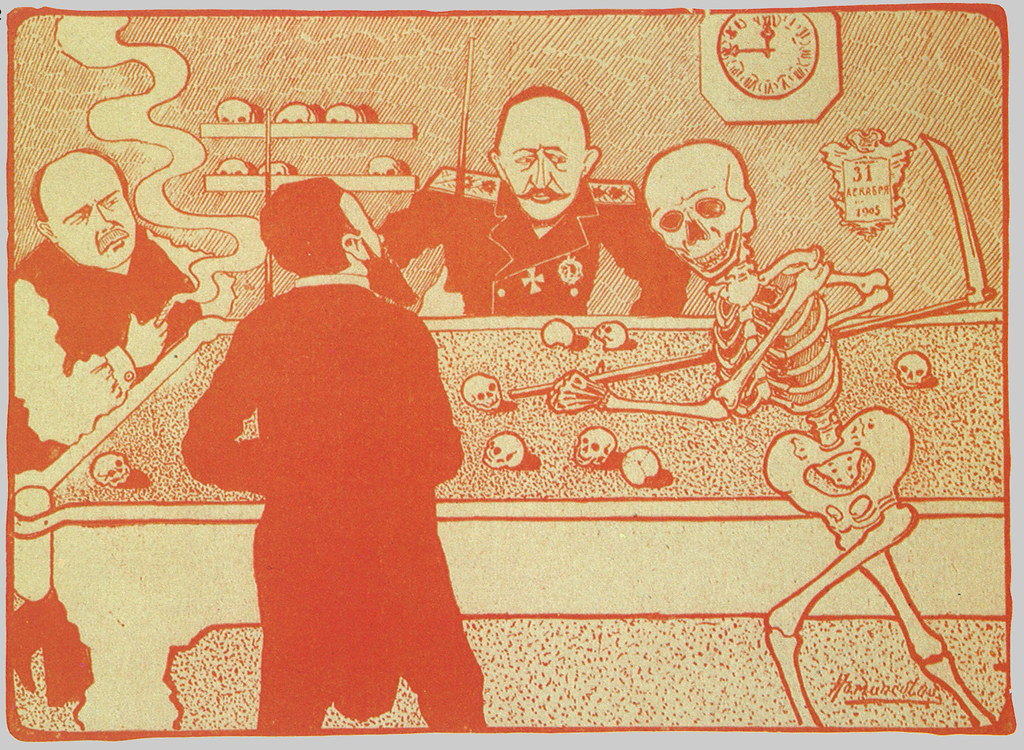
"31 December 1905" Burelom (Storm-Wood), Christmas 1905. Facing is Drubasov, the Governor-General of Moscow and organizer of the suppression of the Moscow uprising, and Prime Minister Witte is shown with his back turned, playing with death.


from Zarevo (Dawn) No. 3, 1906


from Zarnitsy (Summer Lightning) No. 1, 1906


-

All of the images come from David King and Cathy Porter's Blood and Laughter : Caricatures From the 1905 Revolution [link]
I haven't yet got my hands on it but David King and Cathy Porter also published Images of Revolution: Graphic Art from 1905 Russia [link]
also, once again, see Yale University's collection at Beinecke Rare Book & Manuscript Library [link]
my previous post on the subject [link]
see Trixie Treat's post on the journals [link]

Tuesday, May 12, 2009

Edward Hull Illustrations of "Death's Ramble"

The following are illustrations "designed & done on stone" by Edward Hull for Thomas Hood's poem "Death's Ramble". They were printed by C. Hullmandel and published at The Gallery No. 27 Regent St. in London in December 1827.


One day the dreary old King of Death
Inclined for some sport with the carnal,
So he tied a pack of darts on his back,
And quietly stole from his charnel.

His head was bald of flesh and of hair,
His body was lean and lank,
His joints at each stir made a crack, and the cur
Took a gnaw, by the way, at his shank.

And what did he do with his deadly darts,
This goblin of grisly bone?
He dabbled and spill'd man's blood, and he kill'd
Like a butcher that kills his own.

The first he slaughter'd, it made him laugh,
(For the man was a coffin-maker,)
To think how the mutes, and men in black suits,
Would mourn for an undertaker.

Death saw two Quakers sitting at church,
Quoth he, "We shall not differ."
And he let them alone, like figures of stone,
For he could not make them stiffer.


He saw two duellists going to fight,
In fear they could not smother;
And he shot one through at once--for he knew
They never would shoot each other.

He saw a watchman fast in his box,
And he gave a snore infernal;
Said Death, "He may keep his breath, for his sleep
Can never be more eternal."

He met a coachman driving his coach
So slow, that his fare grew sick;
But he let him stray on his tedious way,
For Death only wars on the quick.


Death saw a toll-man taking a toll,
In the spirit of his fraternity;
But he knew that sort of man would extort,
Though summon'd to all eternity.

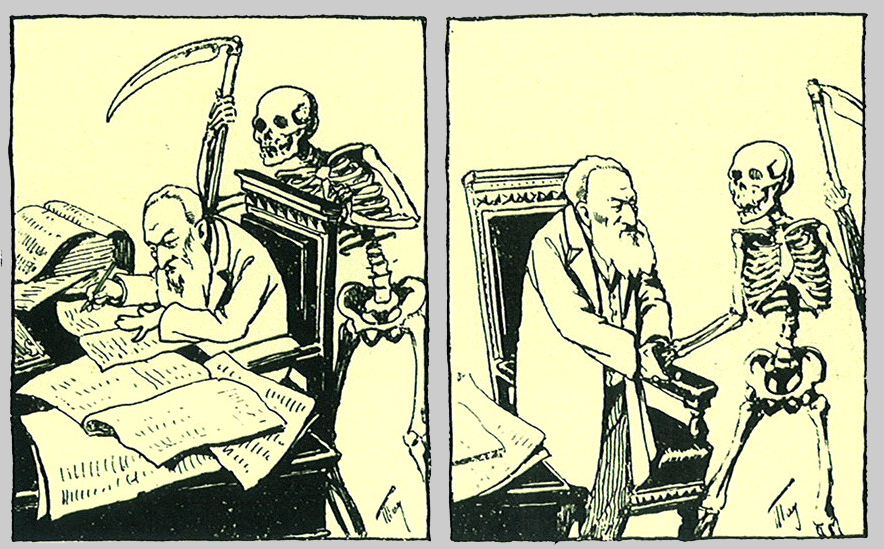
He found an author writing his life,
But he let him write no further;
For Death, who strikes whenever he likes,
Is jealous of all self-murther!


Death saw a patient that pull'd out his purse,
And a doctor that took the sum;
But he let them be--for he knew that the "fee"
Was a prelude to "faw" and "fum."


He met a dustman ringing a bell,
And he gave him a mortal thrust;
For himself, by law, since Adam's flaw,
Is contractor for all our dust.


He saw a sailor mixing his grog,
And he marked him out for slaughter;
For on water he scarcely had cared for Death,
And never on rum-and-water.

Death saw two players playing at cards,
But the game wasn't worth a dump,
For he quickly laid them flat with a spade,
To wait for the final trump!


-
the illustrations were found at US National Library's Images of the History of Medicine [link]
more Thomas Hood can be read at Project Gutenberg [link]
Monday, April 13, 2009

Russian Revolutionary Periodicals 1905-1906

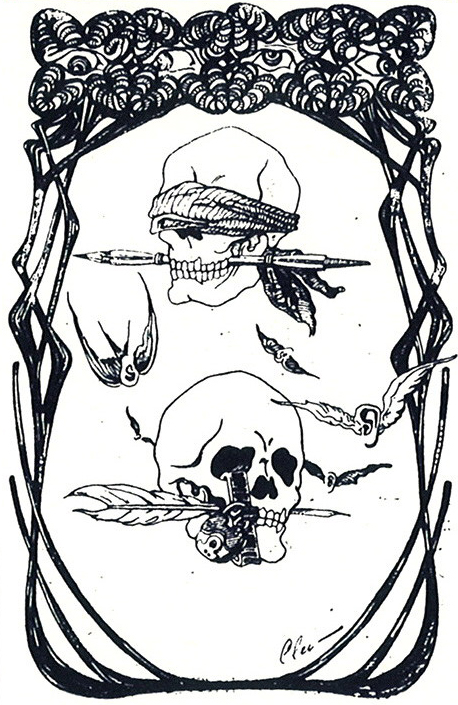
"On Sunday, January 9th, 1905, Tsar Nicholas II ordered trooops to fire on a peaceful procession of workers demonstrating in St. Petersburg, unleashing a storm of strikes, mutinies, violent uprisings, and brutal reprisals that raged across Russia for well over a year. Known collectively as the Revolution of 1905, these upheavals transformed the political landscape and set the stage for the Russian Revolution of 1917 and the Civil War that followed. Bloody Sunday also marked an important watershed for Russian graphic artists. With the momentary collapse of censorship, over 300 different satirical magazines were published during the Revolution of 1905, more than had seen the light of day in Russia during the entire 19th century. Most of them survived for only a few numbers before the censors caught up. Yet the output was impressive all the same. Rushing to fill the expressive void, artists and writers captured the events and personalities of the revolution with biting satire and aesthetic sophistication. While styles and subject matter varied, artists often chose to depict nightmarish scenes of bloodshed and repression, drawing on images of the macabre and the mystical that had already been in vogue in Symbolist circles across Europe at the turn of the century." - from Beinecke Rare Book & Manuscript Library

Zalp
, No. 1 (1906)


Svietaet, No. 2 (1906)


Zarnitsy, No. 3 (1906)


Zanoza, No. 2 (1906)


Ovod, No. 1 (1906)


Zhupel, No. 3 (1906)


Zhupel, No. 2 (1905)


Zhupel, No. 2 (1905)


Iumoristicheskii almanakh, No. 63 (1906)


Maski, No. 1 (Feb 1906)


Shut : khudozhestvennyi zhurnal karikatur, No. 36 (1906)


Maski, No. 1 (Feb 1906)


Zritel, No. 19 (1905)


Skorpion, No. 2 (Feb 1906)


Buria, No. 4 (Jan 1906)


Gamaiun, No. 1 (1906)


Voron, No. 1 (1906)


Karikaturnyi listok gazety gazet
, No. 1 (1905)


Deviatyi val, No. 2 (Jan 1906)


Burelom, No. 3 (Jan. 1906)


Zarevo, No. 1 (Feb. 1906)


-See the whole stunning collection of Russian Graphic Art and the Revolution of 1905 at Yale University's Beinecke Rare Book & Manuscript Library [link]
 
*please cite or link when reposting*